
Florida "Kids"
A Lee County native grapples with the decision to raise her own family in her hometown. She argues that other young professionals and parents who chose to call Lee County home should involve themselves in making the changes they would like to see. Our fact-check rides at the bottom.
By Heather Cook Gonzalez · August 9, 2026
I'm a 37-year-old Lee county native. That used to be a pretty rare thing. Not anymore. The Florida kids I grew up with are now Florida adults. We are professionals and parents. We pay taxes, we own homes, we vote. And it's time we took the lead.
My northern-born parents met in 1985 on Sanibel island where my mom waited tables and my dad cut lawns. Three years later I was one of the first babies born in the new maternity wing at Cape Coral hospital. I spent my whole childhood in the dream house my parents built on a freshly-cleared lot in Southwest Cape. It might as well have been the little house on the prairie for how flat and grassy and empty it was in those days. Little by little, the quarter-acre lots on our street filled up with other families just like ours, looking for an affordable place to start new lives. It was a classic 90s upbringing: my friends and I rode our bikes until the street lights came on, made forts along the canals under Australian pines, and jumped from one pool to another all summer long. I went to good schools - Cape Coral Elementary, Trafalgar Middle, and Fort Myers High. I worked weekends cleaning houses on Sanibel with my aunt and uncle and I spent my hard-earned cash at the Edison mall.
Minus the sandspurs, it was pretty idyllic. But by the time I was 17, I knew I would leave. In the typical mentality of an angsty teen, I grew to be angry and embarrassed of my home town. Why are there so many strip malls? It's just car washes, storage units, car washes, storage units, smoke shops, car washes, and storage units! Where is the culture? Where are the sidewalks? And in Cape Coral one even had to wonder, where are the trees?! Almost none of the adults I knew actually grew up here and almost everyone I'd heard of who grew up here moved away as an adult. As my parents became more successful in their careers we started taking nicer vacations and I saw what "real" cities looked like. The museums! The parks! The public transit! This was surely the life for me and all of my college-bound friends agreed. Southwest Florida was not for us. We were too educated, too cultured, and too idealistic. Many in my diverse group had even stronger reasons to defect: they felt too brown, too queer, or simply too "different" to ever hope for happiness in such a backward place.
So I left. For 12 years I did stints ranging from 3 months to 5 years in Tallahassee, DC, Paris, New York, Cleveland, Miami and Madison. I picked up 2 degrees and a loving husband (also a Floridian) along the way. But nothing ever felt quite right. Madison, Wisconsin was our last stop in the search for a place to settle down. It seemed like a progressive paradise. We toured homes, got library cards, bought snow boots! But in our second winter there, while expecting our first child, I broke. My lips and knuckles were cracked from the cold and, as I strained to button my coat over an impossibly pregnant belly, I cried. My body and my soul craved sticky salty air, the warm embrace of my parents, and the slow languid roll of Gulf shore waves. I missed good mangoes, good shrimp, good (aka Cuban) coffee. And damn it, I was sick of wearing closed-toed shoes all the time.
So we moved back. "This place isn't perfect," I told myself, "but it's home." With a newborn baby and recent experience in a polar vortex, corrupt conservative politics suddenly seemed like a fair price to pay for sunny skies and free babysitting.
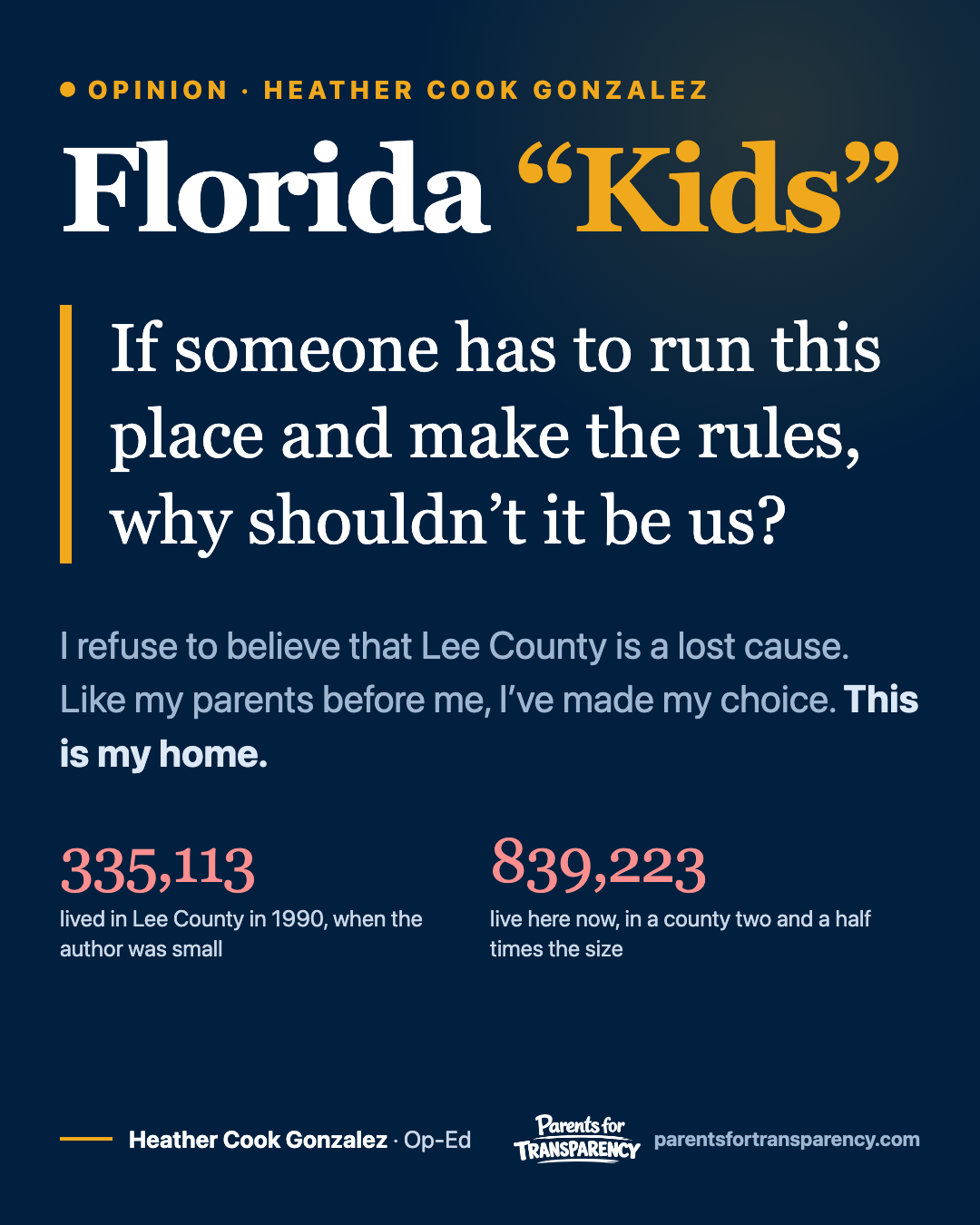
My story isn't unique. More and more people I meet in my age bracket have a similar history and relationship with Florida. Some who grew up here, like me, and others who found themselves here by following jobs or a spouse. We are conflicted. There is plenty about this place to love, things we don't want to give up. But at the same time we question if this is the best place to raise our kids. The traffic keeps getting worse, the schools keep losing funding, and the safety and services necessary for a better quality of life for young families are lacking. But what if it didn't have to be this way? Ingrained as they may seem, the politics, and most certainly the politicians, of any given place are changeable. This is, after all, a democracy... isn't it? Why don't those of us who think something should be done, actually do something? My peers in this community are smart and capable people. They are teachers, doctors, lawyers, business owners, mothers, and fathers. We are not the children we once were - we are confident adults with the tools to shape our futures. If someone has to run this place and make the rules, why shouldn't it be us?
I'm embarrassed to admit that this has only recently dawned on me. I've been inspired by the few people I know who are already doing it. One friend was annoyed by the out-dated rules enforced by her HOA, so she became the President and changed them. Another was upset by the conditions at the school where she taught, so she spoke up at a School Board meeting. Amber Cebull was frustrated by the special interests running our school district, so she co-founded a grassroots movement platform called Parents for Transparency. And my friend Elliot Taylor decided enough was enough when his daughter's beach birthday party was canceled due to polluted water. So he's running for County Commissioner. It's not about changing things from red to blue; it's about honest, caring, and invested citizens stepping up to act in the interest of their communities. Amanda Cochran is a Republican who holds the simple belief that the elected Commissioner from District 5 should be both elected and from District 5. So I voted for her. The leadership of our county should be made up of real people, not the proxies of powerful real estate developers.
Local politics aren't sexy. Showing up and speaking out is a lot scarier than reposting an Instagram reel. But those of us who choose to build our lives here have the responsibility and the opportunity to make this place something we're proud of.
I don't know how far we can get or how fast we can do it. But I refuse to believe that Lee County is a lost cause. Like my parents before me, I've made my choice. This is my home. It may never be perfect, but I can be a part of making it better. When I see my very own Florida kids picking up shells on the beach hand in hand with their grandmother, I have no regrets.
If this landed: Find out what is actually on your August 18 ballot, and where to vote
Fact check
The checkable claims hold up, with two qualifications. Lee County has grown from 335,113 people in 1990 to 839,223 in 2025, so the shrinking odds of meeting someone who grew up here are real. The commissioner she is describing was appointed rather than elected, and moved into the district weeks after the seat came open, which is what her sentence says. The traffic claim is supported by the county's own transportation planning. The schools claim is supported for state operating dollars and for staffing, but the district's total budget has not shrunk, so we mark it mixed. Her characterizations of Southwest Florida, of conservative politics, and of who deserves to hold office are opinion and are labeled below.
This is a memoir. Most of it is one person's account of her own childhood, her own move away, and her own decision to come home, and there is no public record against which anyone can check whether the Australian pines were good for forts. We fact-check the parts a reader could check: the claims about the county, the claim about the schools, and the claims about the people she names. This piece also names two candidates in a county race that is on the ballot in nine days, and says who the author voted for. That is her opinion in her own piece, published under the same rule as every other op-ed here, and it is not this organization's endorsement of anyone. We do not endorse candidates. What we can do is put the filed numbers for both District 5 candidates in front of you, which is what the last entry below does.
Checked Lee County's population history, the district's own budget and staffing decisions, commute and growth data, the appointment and residency of the District 5 county commissioner, the filed campaign finance reports of both District 5 candidates
Growing up in Lee County used to be rare, and the county she left is not the county she came back to.
Supported by the state's own numbers. The Florida Office of Economic and Demographic Research puts Lee County at 205,266 people in the 1980 census, 335,113 in 1990, 440,888 in 2000, 618,754 in 2010 and 760,822 in 2020, with a 2025 estimate of 839,223. That is a county two and a half times the size it was when the author was a small child, and up 10.3 percent since 2020 alone. Population density went from 548.6 people per square mile in 2000 to 1,074.5 in 2025. EDR's projection has Lee passing one million by 2040. The same profile lists 18.9 percent of residents as foreign born and 4.1 percent of residents aged 1 and over as having lived in a different state one year earlier, which is the churn she is describing from the inside.
The traffic keeps getting worse.
Supported by the planning record rather than by feel. Lee County's own long-range transportation planning identifies a multibillion dollar gap between the road capacity the county has and the capacity its projected growth requires, with figures around $4.3 billion cited in 2025 coverage of the Metropolitan Planning Organization's work. Southeast Lee County is projected to grow several times over in the next 25 years and Lehigh Acres is projected to roughly double. Growth of that shape on the existing road network is the mechanism behind her sentence. We are not putting a specific congestion index on this, because the widely circulated Lee commute statistics trace back to law firm marketing pages rather than to a transportation agency, and we do not cite those.
The schools keep losing funding.
True for state operating dollars and for staffing, not true as a statement about the district's total budget, and the difference matters. On her side: the district's April 14, 2026 budget overview projected a $92.4 million operating shortfall for 2026-27, and closing it involved moving $45.4 million out of the capital budget into operations and eliminating 457 positions, 275 of them teaching jobs, through non-renewal. The July 21, 2026 board agenda carried a budget amendment containing a $6,696,856 FEFP reduction and a $1.28 million Title I reduction. Florida's average teacher salary ranks 50th of 51 nationally, which sets the ceiling Lee is paying under. Against her: Lee's overall budget has not shrunk in nominal dollars, enrollment growth brings state money with it, and a balanced budget is a legal requirement rather than a sign of trouble. The accurate version of her sentence is that per-student operating money and classroom staffing are under pressure, not that the district is being defunded.
Elliot Taylor is running for County Commissioner.
Confirmed against the filed record. Elliot Taylor is a qualified candidate for the Lee County Board of County Commissioners, District 2, running as a Democrat against the Republican incumbent Cecil Pendergrass. His filings are on our County and City Races page, pulled from the Supervisor of Elections. The reason he gives here for running, a beach birthday party canceled over water quality, is a personal account and is not independently verified, though water quality advisories affecting Lee County beaches are routine and documented.
The District 5 commissioner should be both elected and from District 5.
Both halves of that description match the record, and readers should have the facts underneath it. Governor Ron DeSantis appointed Patricia "Trish" Petrosky to the District 5 seat on December 12, 2025, after the death of Commissioner Mike Greenwell, and she was sworn in on December 15. She was not elected to it. On residency: press coverage at the time of the appointment reported that she and her husband filed paperwork showing they had purchased a home in the Alva area, inside District 5, about three weeks after Greenwell died. She now lives in the district she represents, which is what Florida requires, and she announced her candidacy for the seat before the appointment was made. Fair to note on the other side: an appointment to fill a vacancy is entirely lawful, it is how Florida fills county commission vacancies, and Lee County commissioners are voted on countywide rather than only by their district's residents, so "from District 5" is a residency question, not a question about who elects the seat.
So I voted for her, and this is decided August 18.
The vote is possible and the timing is right, and there is something here every Lee County voter should know. Vote by mail and early voting for the August 18, 2026 primary are underway, so a ballot cast before this piece was submitted is ordinary. More important: District 5 drew only two candidates and both are Republicans, which under Florida's constitution makes it a universal primary contest. That means every registered Lee County voter, of any party or of none, gets to vote in it on August 18, and it is settled that day with no November round. The same is true of two of the four school board races on this ballot, District 1 and the at-large District 6 seat, each of which drew two candidates. District 4 and District 5 on the school board drew four and three candidates, so those go to November unless someone clears 50 percent.
The leadership of our county should be real people, not the proxies of powerful real estate developers.
That is her judgment, not a finding, and we are not going to grade an opinion. What we can do is put the filed money in front of you for both District 5 candidates, through their July 31, 2026 reports, from the Supervisor of Elections. Trish Petrosky has raised $286,496, of which $81,000 is tagged developer or real estate money, $38,500 is PAC money, $46,100 is out of state, and $510 came in gifts under $100. She has self-funded nothing. Amanda Cochran has raised $192,226, of which $136,900 is her own money, roughly 71 percent of her total, with $7,500 tagged developer or real estate, no PAC money and $3,211 in gifts under $100. The complicating fact the author does not mention: Cochran is co-owner of a real estate brokerage, RE/MAX River and Ranch, and much of her support comes from her own family. Neither profile is disqualifying and neither is illegal. Both are on our County and City Races page for anyone who wants to read the rows themselves.
Corrupt conservative politics, a backward place, and the rest of her characterizations of Southwest Florida.
Opinion, labeled as such, and left in her words. She offers no specific instance of corruption and names no official, so there is no claim here to run against the record. It is worth pointing out an internal tension the author leaves in the piece herself: she writes that this is not about changing things from red to blue, and the candidate she says she voted for is a Republican. Publishing this is not this organization's agreement with her characterization of any party. We publish pieces we disagree with.
Her own life: her age, being among the first babies born in Cape Coral Hospital's new maternity wing, twelve years away, two degrees, and the schools she attended.
Her account of her own life, offered as memoir and not independently verified. We tried to confirm the maternity wing detail and could not find a public source that documents when Cape Coral Hospital's obstetrics unit opened, so we are neither confirming nor disputing it. One arithmetic note for readers keeping track: parents who met in 1985 and a birth three years later would put her birth in 1988, which squares with being 37 or 38 in August 2026 depending on her birthday.
Fact-check sources
- Florida Office of Economic and Demographic Research - Lee County area profile (census counts, estimates, density, projections)
- Governor's office - appointment of Patricia "Trish" Petrosky to the Lee County Board of County Commissioners, December 12, 2025
- WGCU - DeSantis appoints Petrosky to the Lee County Commission (including the Alva home purchase)
- Cape Coral Breeze - Universal primary is at play in the District 5 race
- Fla. Stat. 105.051 - determination of election or retention to office in a nonpartisan race
- School District of Lee County - Budget Realignment and Non-Renewal Process
- Full agenda packet, Lee County School Board, July 21, 2026 (BoardDocs)
- WGCU - Creative planning may be key to finding billions to help drivers get around Lee County
- Our County and City Races page - the filed reports for both District 5 candidates
- Our Teacher Pay tracker - where Florida ranks nationally
- Our District Budget Watch - the shortfall, the capital transfer and the staffing cuts
About the author
Heather Cook Gonzalez Heather grew up in Cape Coral, FL and graduated from Fort Myers High School. She has a bachelors degree from Florida State University and a Masters from Case Western Reserve University. Heather is a mom, a gardening teacher, and an active volunteer. She lives in Fort Myers with her husband and two children. (Photo: Allison Union Photography.)